Midnight Baptism


Once upon a time…
In the heart of the Peneda-Gerês National Park , between the Serra do Soajo and Serra Amarela mountain ranges, in the deep valley carved by the Lima River, one of the most unique traditions of Alto Minho was born: the Midnight Baptism . Legend has it that when a woman approached the last months of her pregnancy, the baby was baptized in the womb with water from the Lima River, exactly at midnight, in order to protect both mother and baby.

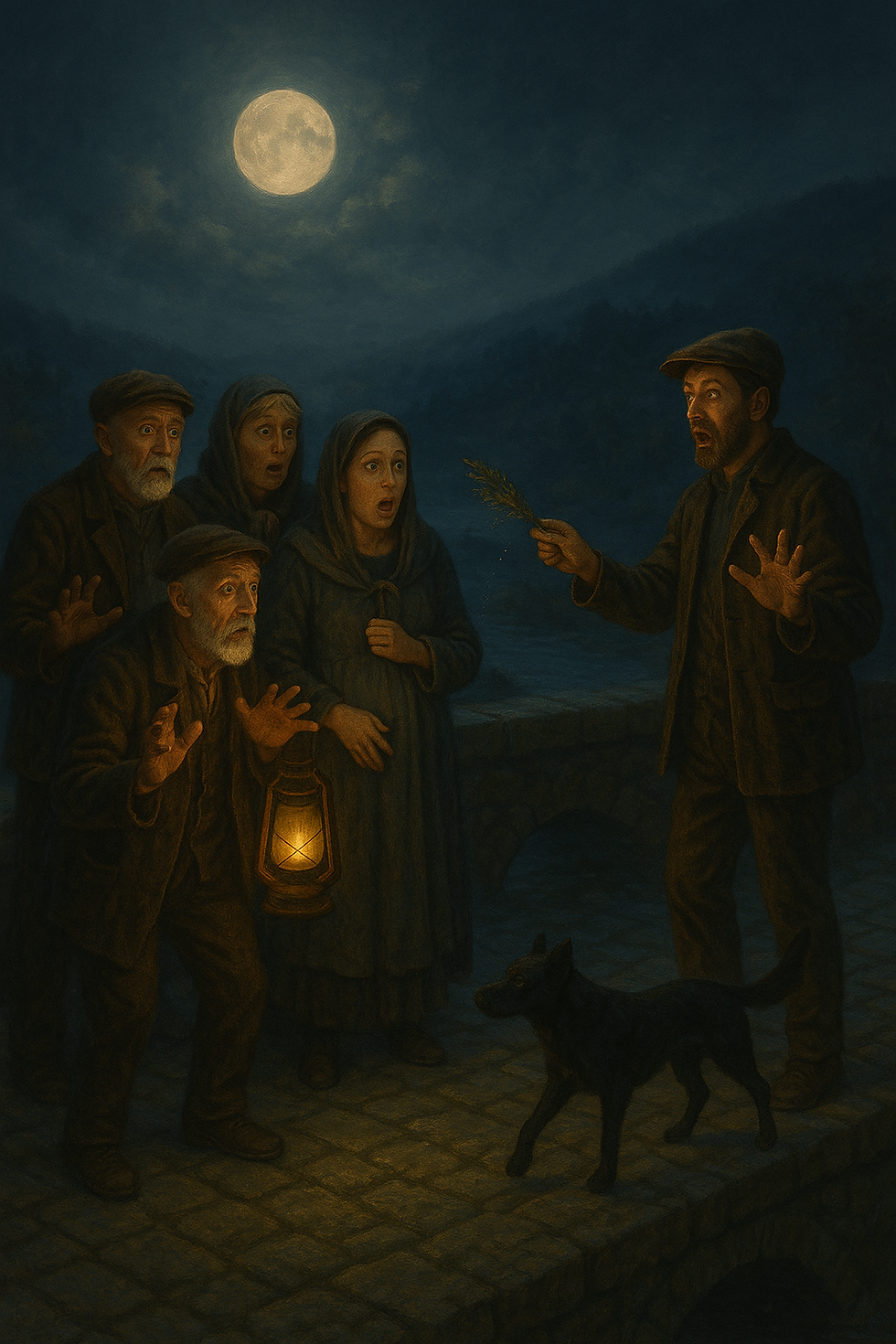
Accompanied by her husband and closest relatives, the expectant mother would descend from the most rugged villages in the mountains of Arcos de Valdevez and Ponte da Barca, often along dangerous, cobbled paths illuminated only by the light of a lamp, until she reached the banks of the Lima River or a bridge that crossed it. When the right moment arrived, neither before nor after the twelve chimes, a relative would wait for the first person to pass by. This person was invited to become the child's godparent in that urgent and sacred ritual. If they accepted, they would collect water from the river and, with an olive branch, sprinkle the woman's belly, tracing a cross and pronouncing: "I baptize you, in the name of the Father, and of the Son, and of the Holy Spirit." But without saying "Amen," as that final closing belonged only to the priest in the official baptism, after the birth. However, PLEASE NOTE that if a dog or cat crossed the path, the ritual was canceled, as it was believed to be "bad luck," and the baptism would have to be postponed to another night.
Myth or Reality?
Unlike many popular legends from Alto Minho, such as the Legend of the Accompaniment , which clearly belongs to the supernatural imagination, the Midnight Baptism was a common ritual between the 18th and 20th centuries in the communities of Alto Lima.
What is the origin of this ritual?
This ritual is believed to have originated from two main causes:
Practical origin: Initially, the first episodes of this ritual occurred due to the high infant mortality rate of the time, in which, due to the absence of medical care, without trained midwives and with long distances to the parishes, mothers resorted to what they had at their disposal: faith.
Folkloric origin: In a second phase, the ritual may have acquired a social and folkloric dimension, ceasing to be merely an emergency practice and transforming into a community pattern, as happens with so many traditional rituals, from weddings to pilgrimages.

Why was baptism performed at midnight?
Although there is no concrete reason, there are several possible reasons for performing baptisms at midnight:
Catholic tradition: At a time when the church held power, performing any ceremonies outside of Catholic tradition could be seen as witchcraft, disorder, insubordination, etc., therefore it was done at night so that no one would find out.
What nobody knows, nobody spoils: The ritual was performed at night in order to avoid the evil eye and the judgment of those who didn't wish them well.
The passage: Since time immemorial, the twelve chimes (midnight) have held a strong mystical energy, marking the transition between days, and even years, where it was believed that prayers were strongest and gestures purest.
.jpg)
.jpg)
.jpg)
.jpg)
.jpg)