The Sweeping of the Valdevez Fair


Once upon a time...
In Northern Portugal, more specifically in the Peneda-Gerês National Park region, the "pau" (stick), also known as a rod, staff, walking stick, or marmeleiro, played a fundamental role in the life of the people who faced harsh winters and arduous work in a rugged and active environment. The stick served as an essential tool for handling the animals that daily assisted in agricultural tasks, as a third leg of support on long walks along rugged trails, and also for defense against enemies, wolves, and wild boars. In short, this simple but versatile instrument was inseparable from rural people, accompanying them in all facets of daily life.

The inhabitants of Soajo , known as Soajeiros or Monteiros, never readily accepted the administrative sovereignty ofArcos de Valdevez as the seat of the council. Soajo is now a parish, but in the past it was a town that was the seat of a municipality composed of three parishes: Soajo, Ermelo, and Peneda . Therefore, whenever it was mentioned in Arcos de Valdevez that the Soajeiros wanted to descend upon the town in a hostile manner, the alarm was considerable.

United among themselves, the people of Soajo are commonly known for their independent spirit and combativeness, their bravery, their difference, their parochialism and their spirit, being legendarily represented by the figure of the Judge of Soajo . They were also considered to possess a "restless spirit" at pilgrimages or fairs, where the stick was an indispensable complement to man, and the people of Soajo were feared gamblers.

Once, at the beginning of the 20th century, an event occurred that marked the history of Arcos de Valdevez. A fight between men from Soajo and the town of Arcos de Valdevez, in which the disagreements were so fierce and violent that the daily press gave it news coverage, even though Arcos de Valdevez was outside the major centers. Also, since "Jogo do Pau" (Stick Fighting) is a Portuguese martial art, this event became a legend throughout the country's schools.
According to existing records and the testimonies of the oldest residents, the story was as follows:

In 1902, during the pilgrimage to Our Lady of Peneda , a group of people from Soajeiros clashed with a group of people from the village, where supposedly one of their own had been mistreated. Tempers flared, one word led to another, and it didn't take long for it to escalate into physical violence. There were blows here, slashes there, split heads, but it seems the balance tipped in favor of the men from the valley, perhaps because they were more numerous.
But the worst was yet to come.

Following this event, and to further inflame passions, individuals from near the village (Prozelo) had harassed women from Soajeiros on their way to Arcos, certainly intentionally. However, those who thought they could measure their strength against these fearless mountain men were mistaken.
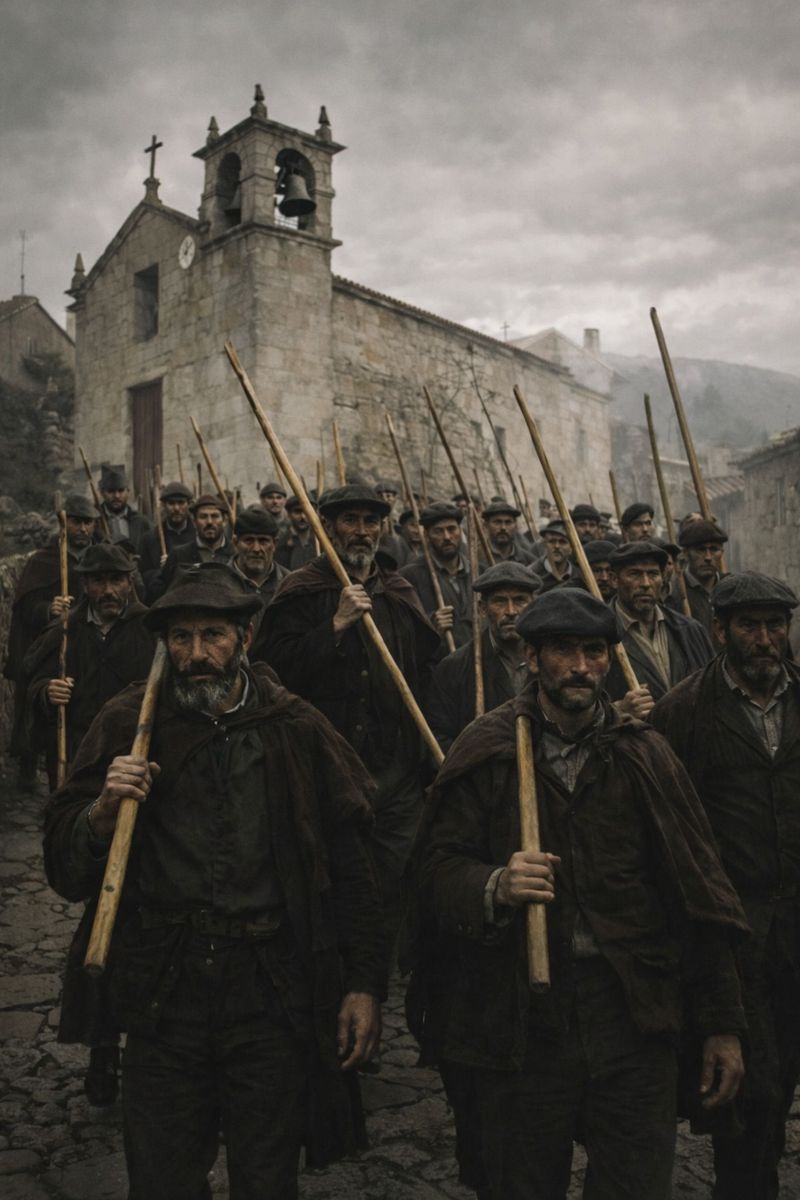
On the day of the usual cattle fair in the village of Arcos, the alarm bell rang in Soajo*, but this time it was to gather all the men of Soajo. In a kind of battalion, they marched en masse down the mountain, intending to march on the village. Local authorities, aware of this agitation, went to meet them halfway (Cabana Maior) to try to dissuade the people of Soajo from such an incursion. But it was all in vain.
*A typical village emergency call used when people needed to respond to, for example, a fire.

Upon arriving at the village, they purposely climbed the cobbled path that led to the cattle market (above the current Largo da Lapa), where the stick pullers, the market sweepers, the masters, in short, those skilled in the art of head-splitting, gathered. Further ahead, a man from Soajeiro walked along with a bouquet of flowers he had picked on the way, which he provocatively forced the men to kiss, hoping that one of them would refuse. It wasn't long before the desired outcome occurred.

This marked the beginning of what became known as the "Sweeping of the Valdevez Fair." With their crude wooden poles, spinning blindly, they rummaged up and down mercilessly.
However, the people of Soajeiros made a mistake, that of indiscriminately criticizing the surprised farmers and livestock contractors who were at the fair, coming from other villages and towns, including Arcos de Valdevez, the largest municipality in Alto-Minho.

That being said, it wasn't long before the impulsive Soajeira strategy had its natural outcome. All those who had a good stick in their hands, after taking the first "blows," responded with a torrent of fighting, thus dispersing the Soajeiros. Besides there being no fair that day, there were also no winners, as everyone lost, including a life. Even more impactful, because there were many fights, was the phrase that the Soajeiros proliferated, in a kind of warning for life:
"When we left Soajo, the bells were already ringing for those who were about to die!"

Regarding the martial art "Jogo do Pau" (Stick Fighting), a demonstration was held during the inauguration of the Casa do Povo de Soajo (Soajo Community Center) on June 28, 1953. Unfortunately, over time, the tradition of this martial art as a recreational activity has been fading. In the parish of Soajo, there are still some men who may preserve some memories, and also in the ethnographic groups who dress in traditional attire accompanied by the feared stick.
.jpg)
.jpg)
.jpg)
.jpg)
.jpg)